Engagement interviews
Know how your people are doing, and why.
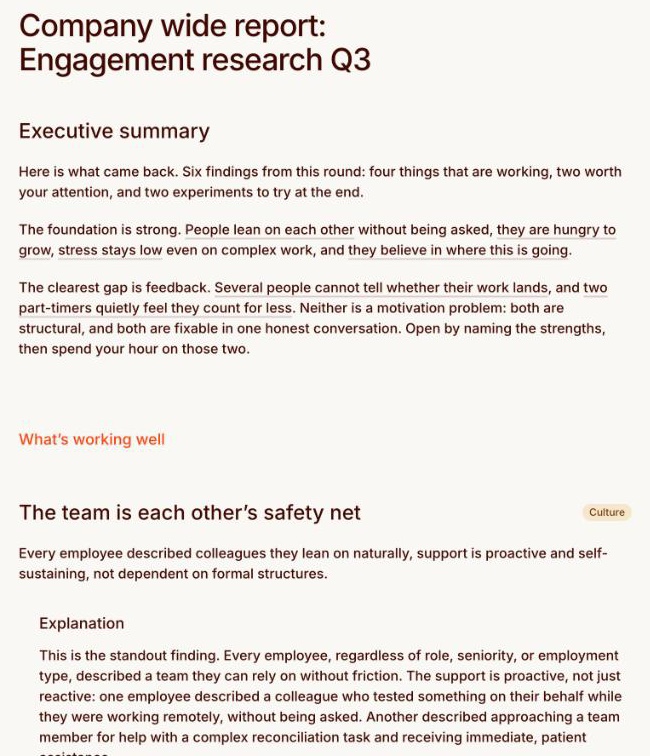
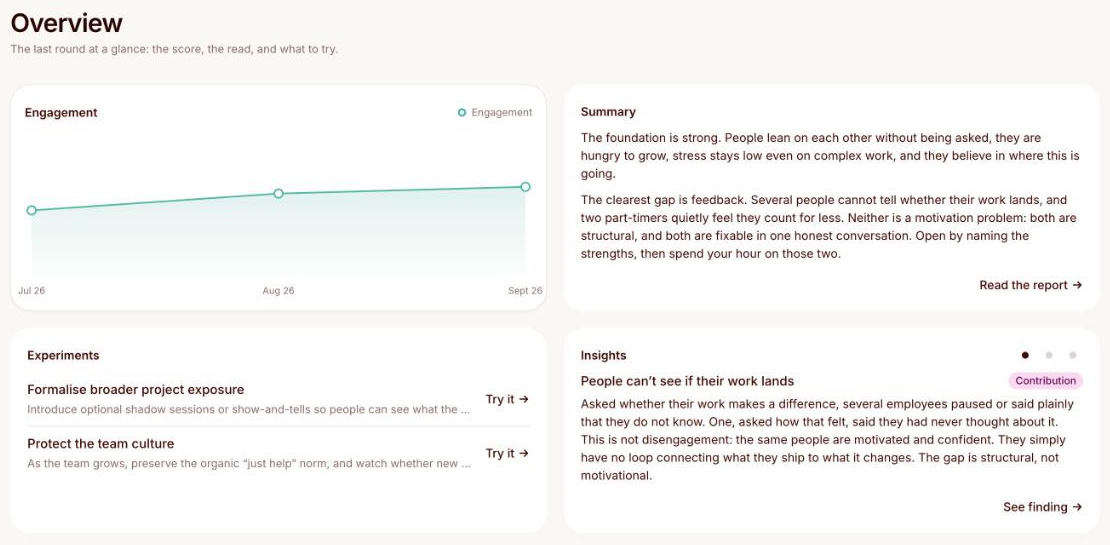
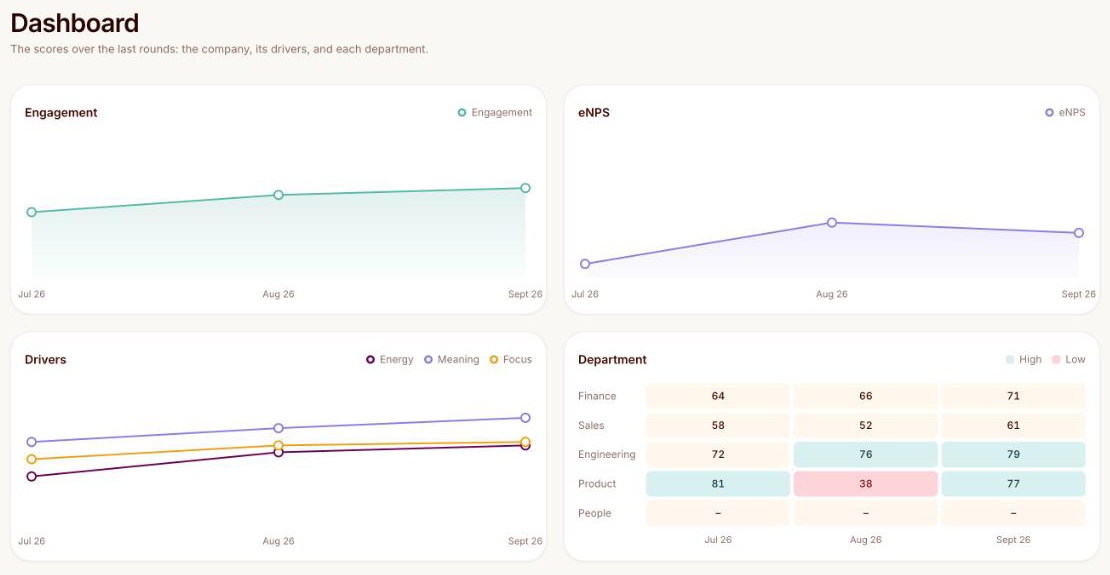
A one-on-one interview with every employee, in their own words. You get the score and the reasons behind it, ready within days.
- Choose the shape
- Invite your people
- Read what came back
Solutions
Spradley holds a one-on-one interview with every employee and turns what they say into insight within days. Start from the question you have.
How people experience their work, and why.
Has the strategy landed, and what stands in its way?
Reorganisations, new tools, new ways of working.
Engagement interviews
A one-on-one interview with every employee, in their own words. You get the score and the reasons behind it, ready within days.
Strategy
A focused interview asks the one question leadership needs answered, and follows up until the answer is clear.
Change
Before a change, hear what people expect. After it, hear what actually happened. Act while it is still underway.
Start from a template, or write the one question you need answered and the themes around it.
Each person gets a personal link by email or Slack and answers in a one-on-one conversation, by text or voice.
Within days you get the themes, the reasons and the quotes, and you can ask Brain what they mean.
The platform
One-on-one depth interviews with every employee, by text or voice.
Answers coded and clustered with qualitative research methods.
Themes ranked by prevalence, with quotes and experiments to try.
Leaders ask about what their people said and get answers with evidence.
Your research in Claude, ChatGPT or Copilot, through the Spradley MCP.
Learn moreSpradley runs a research project with your people for you.
Learn moreWhen researchers really need to understand people, they do not send a form. They sit down with someone and talk. Anthropologists knew it. Sociologists knew it. Every People leader who ever learned more in one exit interview than in a year of dashboards knows it too.
The problem was never the method. It was the math. A good interviewer can hold maybe five conversations a day. At that pace, listening to a 300-person company takes three months, and by the time you finish, the answers have changed.
That constraint quietly shaped everything about how companies listen. Not because anyone believed it was the best way, but because it was the way that fit in a quarter.
That constraint quietly shaped everything about how companies listen. Not because anyone believed it was the best way, but because it was the way that fit in a quarter. Then the math changed. AI made it possible to hold a real conversation, one that follows up, asks for examples, and notices what was almost said, with every person at the same time. Researchers took notice: peer-reviewed studies, including from the London School of Economics, began documenting a method with the depth of the interview and the scale of the census. A new field is forming around AI-moderated interviews. We are building Spradley at its frontier: the first AI interviewer made for employee engagement, grounded in the research, built in Copenhagen alongside the people studying the method itself.
The gold standard, finally at scale.